Soft Wearable Robot for Tremor Suppression
Designed and built a soft wearable actuator that independently tuned damping, enabling upper-limb tremor suppression with less risk of making the joint feel rigid or uncomfortable. The system combined a pneumatic artificial muscle with integrated Nitinol springs and real-time thermal control to stabilize elbow oscillations in a wearable format.
Key results
Up to 50.2% reduction in settling time on a phantom arm and 0.47 to 32.23 mJ tunable energy dissipation (-91.7% to +140.9% relative to baseline) during benchtop characterization.
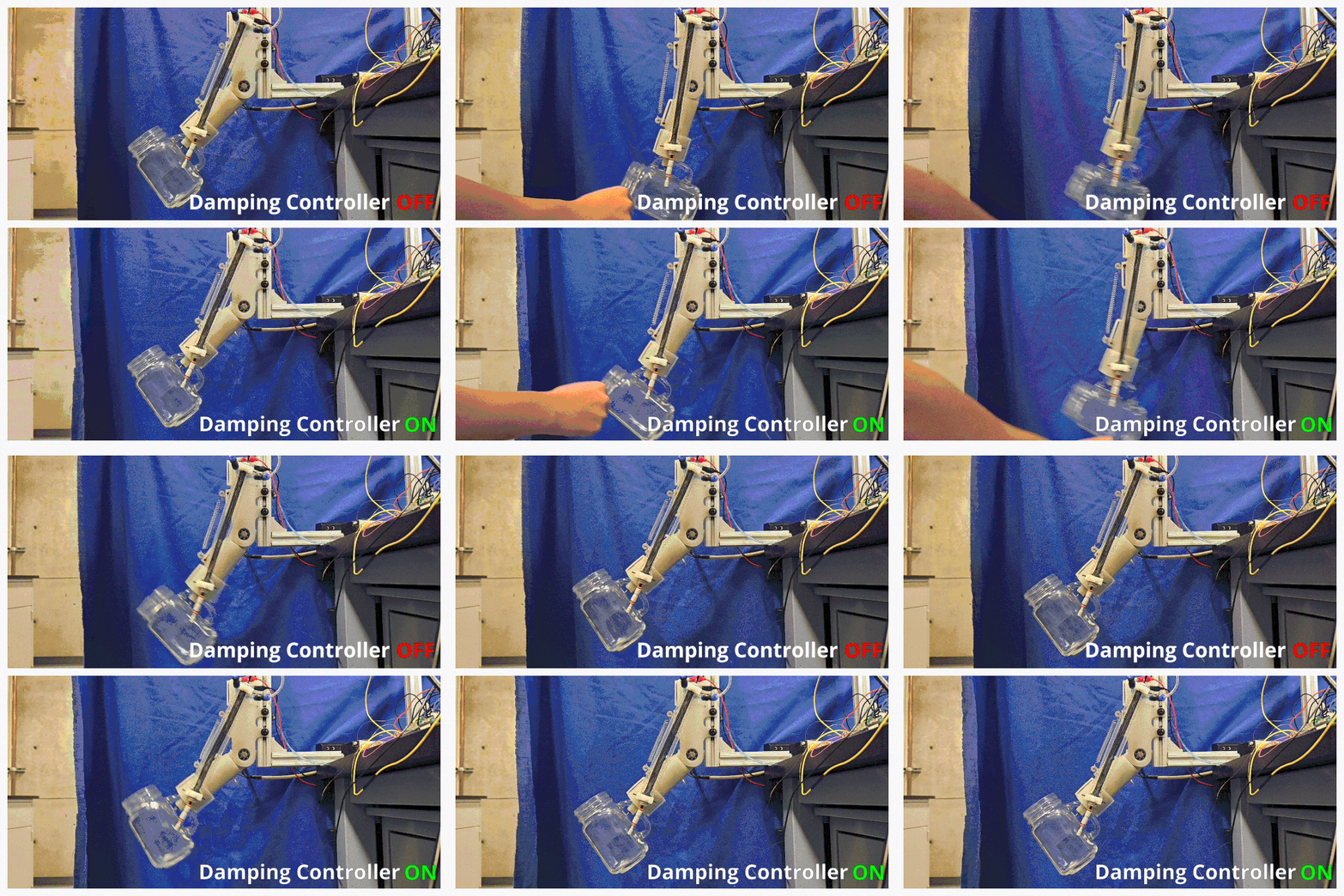
Application-level demonstration of active damping control. With the damping controller enabled, the wearable soft robot dissipates oscillation energy faster and suppresses elbow motion more quickly than the uncontrolled case.
Problem
Most soft wearable robots stabilize motion by increasing stiffness. That can reduce unwanted movement, but it also makes the joint feel more rigid and less comfortable. For tremor suppression, the better target is often damping, which removes oscillation energy without heavily resisting intentional motion. The challenge is that in soft robotics, stiffness and damping are usually coupled, so changing one also changes the other. This project addressed that gap by creating a wearable soft actuator that could modulate damping independently with minimal effect on stiffness.

Target use case: upper-limb assistance during daily activities. The robot was designed to span the elbow and add controllable damping during motion.
Solution
I developed a hybrid soft actuator that paired a McKibben-style pneumatic muscle with two Nitinol springs mounted along the actuator body. The key idea was to exploit the temperature-dependent hysteresis of the Nitinol. By heating the springs during one phase of elbow motion and cooling them during the other, the actuator could change how much energy it dissipated per cycle. That enabled active damping control while keeping stiffness nearly constant.
The actuator could both increase damping and decrease damping depending on the timing of the temperature cycle. In benchtop testing, the soft actuator achieved an energy-dissipation range of 0.47 to 32.23 mJ, corresponding to -91.7% to +140.9% relative to an uncontrolled baseline, while limiting stiffness change to 8% max. In phantom-arm testing, the robot reduced oscillation settling time by up to 50.2%, showing that the concept translated from controlled characterization to a wearable demonstration.

Working principle of soft robot on arm. Heating the SMA during extension and cooling during contraction increases energy dissipation; reversing that temperature cycle decreases it.
Design and fabrication
The actuator was built around a McKibben style pneumatic muscle that provided the main assistive force. I fabricated the base actuator by placing a silicone bladder inside a braided PET sleeve so the structure would shorten axially when pressurized. To keep the device wearable and compact, the geometry was sized around an elbow-assist use case, resulting in a 206 mm length and 9 mm diameter prototype that could generate useful elbow torque while staying narrow enough for comfort.
To add independently controllable damping, I integrated two linear Nitinol springs along the sides of the actuator. Each spring was pre-stretched and packaged inside a silicone tube that served as a forced-air cooling channel. This created a hybrid actuator where the pneumatic core generated motion and the Nitinol layer tuned dynamic response.
The full assembly was packaged using custom 3D-printed end caps that clamped together the bladder, braided sleeve, Nitinol springs, and cooling channels into one wearable structure. The end caps also provided the attachment features for the human-robot interface. After assembly, the actuator was covered with insulating fabric for user safety, and conditioned through 50 fatigue cycles to reduce early performance drift.
I also developed the supporting thermal and electrical hardware needed for real-time damping modulation. Thermistors measured Nitinol temperature, an Arduino handled sensing and control, Joule heating was regulated through PWM, and solenoid controlled compressed air loop cooled the springs. Sharing the same pneumatic source for both actuation and cooling kept the overall system compact by reducing added bulk.

Hybrid actuator assembly architecture. The design combines a pneumatic contraction actuator, dual SMA springs, forced-air cooling channels, and custom 3D-printed end caps.

First working prototype
To validate the design, I built two separate experimental platforms. First, I created a custom benchtop impedance characterization rig using a linear rail, force sensor, motor, encoder, and closed-loop displacement control. I then ran a 27 condition DOE across three oscillation frequencies, three target temperatures, and three damping control modes. This rig was critical for identifying damping and stiffness behavior and proving that the actuator genuinely decoupled the two.
Second, I built a 3D-printed phantom arm with encoder instrumentation and custom ball-bearing interfaces so the wearable actuator could stay aligned with the arm. This platform was used to evaluate the actuator in a more application-relevant setting by reproducing elbow-like oscillations. It allowed me to verify that the damping gains measured on the benchtop translated to a wearable configuration, reducing settling time and suppressing oscillations while keeping stiffness change minimal.
Custom test rig built to measure actuator impedance. The setup uses a motor-driven linear rail, force sensor, encoder, and thermal/pneumatic control hardware to measure how oscillation frequency and Nitinol temperature change damping and stiffness.
Future work will increase the actuator’s bandwidth for higher-frequency tremor suppression. Planned upgrades include faster temperature feedback using FBG sensors and improved cooling using Peltier-based cooling chambers, followed by an antagonistic actuator layout that adds stiffness control. Together, these changes move the system toward a wearable soft robot with independent control of damping and stiffness for more stable and comfortable upper-limb assistance.

Related Publication
Variable damping of pneumatic soft robots with shape memory alloys.
Lee, K., AfshariNejad, P., Liu, T., Realmuto, J., & Sheng, J. (2025).
Smart Materials and Structures. DOI: 10.1088/1361-665X/adf7ec.